Chair Mold Manufacturing: Materials, Techniques & Best Practices
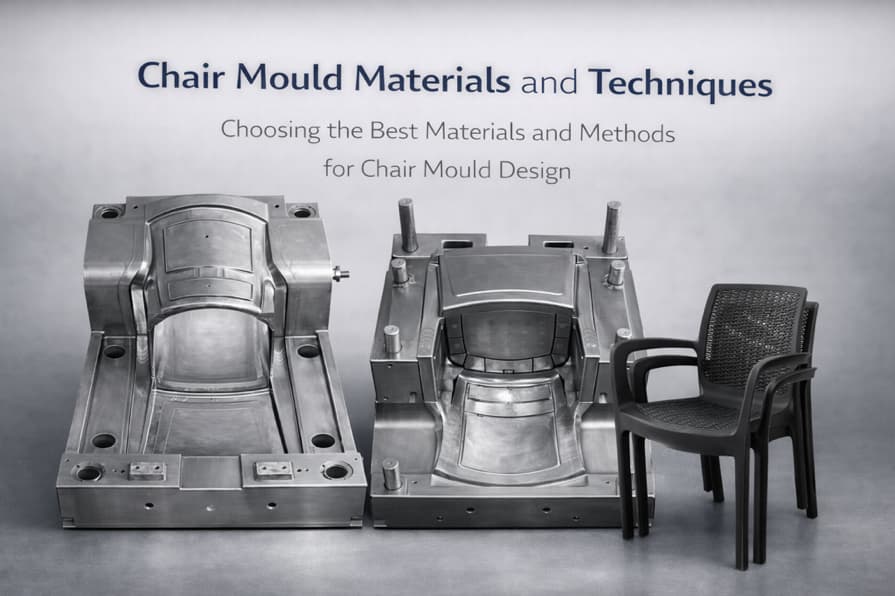
Chair molds represent the pinnacle of injection mold engineering. Here's an in-depth look at what makes a great chair mold.
Why Chair Molds Are Complex
Technical Challenges:
- Large size - Requires robust mold construction
- Structural requirements - Must support human weight
- Aesthetic demands - Visible surfaces everywhere
- Thin walls - Material flow challenges
- Undercuts - Complex ejection systems
Steel Selection for Chair Molds
Recommended Steels:
718H (Most Common)- Pre-hardened (28-32 HRC)
- Excellent polishability
- Good for texture
- 500,000+ shot life
- Higher hardness (37-43 HRC)
- Mirror finish capable
- No heat treatment needed
- 800,000+ shot life
- Stainless steel
- Corrosion resistant
- Best for PP with high glass content
- 1,000,000+ shot life
Steel Distribution:
| Component | Recommended Steel |
|---|---|
| Core | 718H / NAK80 |
| Cavity | 718H / NAK80 |
| Sliders | 718H (nitrided) |
| Lifters | SKD61 (hardened) |
Gas-Assist Technology
How It Works:
- Partial plastic injection
- Nitrogen gas injection
- Gas pushes plastic to walls
- Hollow sections formed
Benefits:
- Weight reduction: Possible 15-30% (design dependent)
- Material savings: Proportional to weight reduction
- No sink marks: Eliminated on thick sections
- Faster cooling: Hollow sections cool faster
Design Considerations:
- Gas channels must be designed in
- Minimum wall thickness: 3-4mm for gas channels
- Gas needle placement critical
- Specialized equipment required
Cooling System Design
Critical for Chair Molds:
- Large surface area requires extensive cooling
- Uneven cooling causes warpage
- Cycle time directly affected
Best Practices:
- Conformal cooling for complex areas
- Separate circuits for different zones
- Baffles in deep areas
- Bubblers for cores
Typical Cooling Times:
- Armless chair: 35-50 seconds
- Armchair: 45-60 seconds
- Stacking chair: 40-55 seconds
Ejection System
Chair-Specific Challenges:
- Large contact area
- Deep cores
- Undercuts from armrests
Solutions:
- Multiple ejector pins (30-50+ pins)
- Stripper plates for even force
- Hydraulic cylinders for sliders
- Air assist for release
Surface Finish Options
Textures (Most Popular):
- VDI 24-30 for hide mark texture
- MT-11015 for leather grain
- Custom textures available
Polished Finishes:
- A2 for high-gloss seats
- B1 for semi-gloss
- Combination finish possible
Quality Control Points
Dimensional Checks:
- Seat height and width
- Backrest angle
- Leg spacing (stacking clearance)
- Overall dimensions
Structural Testing:
- Static load test (100-150kg)
- Dynamic load test (repeated loading)
- Drop test
- Fatigue testing
Common Issues and Solutions
| Issue | Cause | Solution |
|---|---|---|
| Warpage | Uneven cooling | Optimize cooling channels |
| Sink marks | Thick sections | Gas-assist or redesign |
| Flash | High pressure | Adjust clamping force |
| Short shot | Poor flow | Add venting, adjust gates |
| Stress marks | Fast injection | Slow down injection |
Conclusion
Chair mold manufacturing requires experience and expertise. The investment in quality engineering upfront pays dividends in production efficiency and product quality.